Personal View of Aesthetics
By Dr Zhi 'Albert' Li
Formal Beauty and Meaningful Beauty
I tend to think that beauty in art can be divided into two categories: formal beauty and meaningful beauty.
Formal beauty is the beauty of appearance and craft. Painting technique is one example. Meaningful beauty is different. It comes from what a work conveys: meaning, emotion, memory, reflection, or a way of seeing the world. That layer comes from the creator.
After the invention of the camera, formal beauty was fundamentally challenged because formal beauty can be analysed and reproduced. In photography, strong contrast, bright colour, and excellent composition can be combined in the right proportions to create work that looks highly professional. Such work can absolutely be beautiful in a formal sense. But today, formally beautiful images are already everywhere online. They have become part of mass taste. Under those conditions, formal beauty alone often struggles to remain memorable. Something can certainly be beautiful without becoming unforgettable. That is exactly what leads us to a deeper aesthetic pursuit: meaningful beauty.
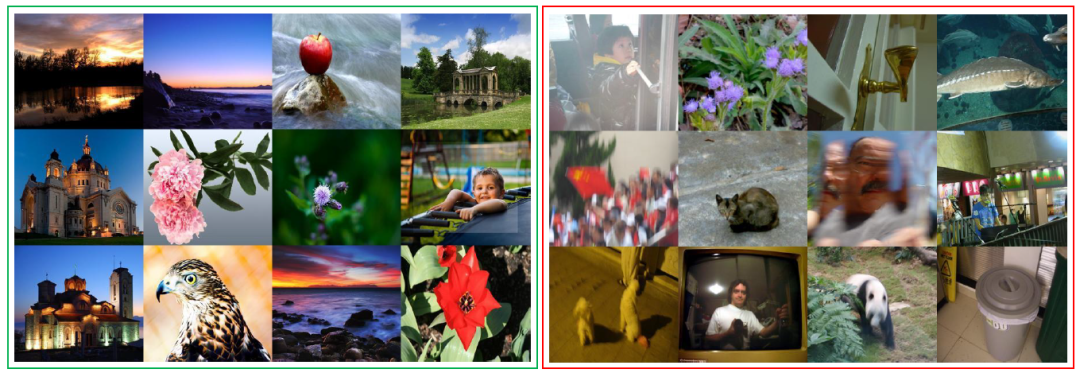
Figure 1. A mathematical model distinguishing professional photographs from casual snapshots. The green region on the left contains professional work; the red region on the right contains casual photos.
Since the invention of photography, impressionism, modernism, and postmodernism have all flourished. Abstract styles became increasingly valued, and the gap between mass taste and professional taste grew wider. In many forms of professional taste, meaningful beauty stands above formal beauty. In other words, whether something is formally beautiful is not the most important question. What matters more is the emotion, lived experience, story, or thought carried by the form.
Artists are often unusually sensitive people. They can use form to express meanings they have felt deeply, and in doing so communicate a beauty that rises above appearance alone. Imagine an artist enthusiastically praising a child's drawing as art. Many people might wonder how such a simple sketch could count as art. But from the perspective of meaningful beauty, the child's drawing may already express feeling, perspective, and thought. That act alone fulfils one of art's deepest functions: expression.
Another good example is Zima Blue from Love, Death & Robots. The artist Zima created many famous works, and then one day a blue geometric shape began to appear in the centre of his paintings. People were confused until his final work revealed the meaning: he, a robot, dismantled himself and leapt into a blue pool, returning to his origin as a pool-cleaning robot. Suddenly all of his work became a closed loop. His entire life had been transformed into art. Looking back, the blue shape may have been the thing he had always been thinking about and longing for, both his beginning and his end.
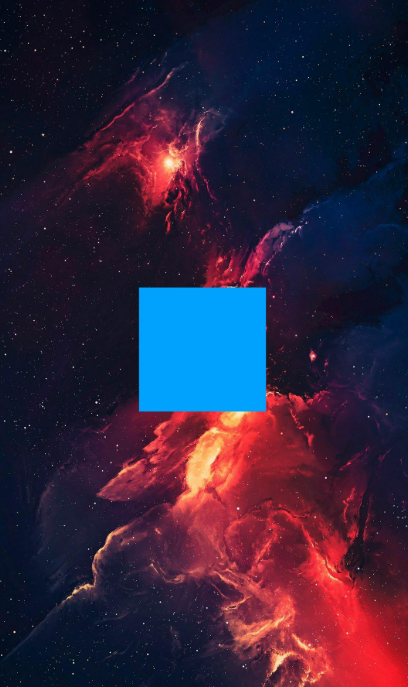
Figure 2. In Zima Blue*, a blue geometric form appears at the centre of the artist's work.*
The Question of Taste
We often say that everyone has different taste. That statement is both true and not true.
It is not true in the sense that a large body of research suggests mass taste does exist. People's overall sense of beauty often converges more than we think, which is exactly why aesthetic training can be taught at all.
It is true, however, at the level beyond formal beauty. When meaningful beauty enters the picture, different people interpret the same work in different ways. Those interpretations are filtered through each person's own memories, experiences, and reflections, and that is where aesthetic differences emerge.
Because of this, I believe the upper limit of a person's taste is closely tied to that person's life experience, while the lower limit is shaped by aesthetic training.
At its core, taste is a kind of sensitivity: the capacity to notice, reflect on, and savour a feeling. Some graphic designers can spot a pixel-level shift in layout at a glance. That is the result of long aesthetic training. By repeatedly examining and refining the details of a work, one eventually approaches an object that feels complete, coordinated, and difficult to improve. At that point, any small change may begin to damage it.
Beauty Created by Artificial Intelligence
Now consider image generation in AI. Researchers extract image features, build mathematical models for aesthetic assessment, and train on datasets to generate new work. But what they are mostly generating is work that satisfies mass aesthetics. That is why these systems do so well in areas where broad appeal matters, such as content recommendation, e-commerce posters, and mainstream visual design.
Those systems quantify widely shared preferences and find visual outcomes that most people are likely to accept. On that level, they are effective.
But at the level of meaningful beauty, I do not think they are enough. What is missing is a real story. A generated image may trigger association or even look convincing in form, but the difference between a fabricated story and a real one can still be felt. Perhaps the real crisis for art will only arrive on the day when AI can independently create stories that are heartbreakingly true and capable of inspiring genuine reflection.
My conclusion is that advanced technologies for producing formal beauty are reducing the cost of aesthetic training and helping visual work reach the level of quality that mass audiences accept. That has clear practical value for commerce, design, manufacturing, and many other fields close to daily life.
But meaningful beauty is different. It does not live in form alone. Anyone can be an artist. A generative technique cannot.
Using generative techniques to create forms that satisfy real human needs is, in my view, more characteristic of design than of art. That is one of the ways design differs from art, even though moving design can sometimes rise into art. So design may change dramatically, but art remains fundamentally irreplaceable, because even if form is achieved, a real story may still be absent.
There are many more differences between design aesthetics and art aesthetics. For example, under the influence of modernism, design often leans toward simplicity, the logic of "less is more." People with engineering training often feel comfortable with that impulse toward simplification. In art history, by contrast, most major styles have leaned toward richness and abundance. Today we live with both impulses at once. That is a separate topic worth exploring another time.
I will end with one sentence that helps me think about this:
If a person stands before a painting for an entire day, what they are really looking at is not the painting, but themselves.